 (028) 9070 6940
 sales@laserproto.com
 See Case Study and Rocket in Action Here
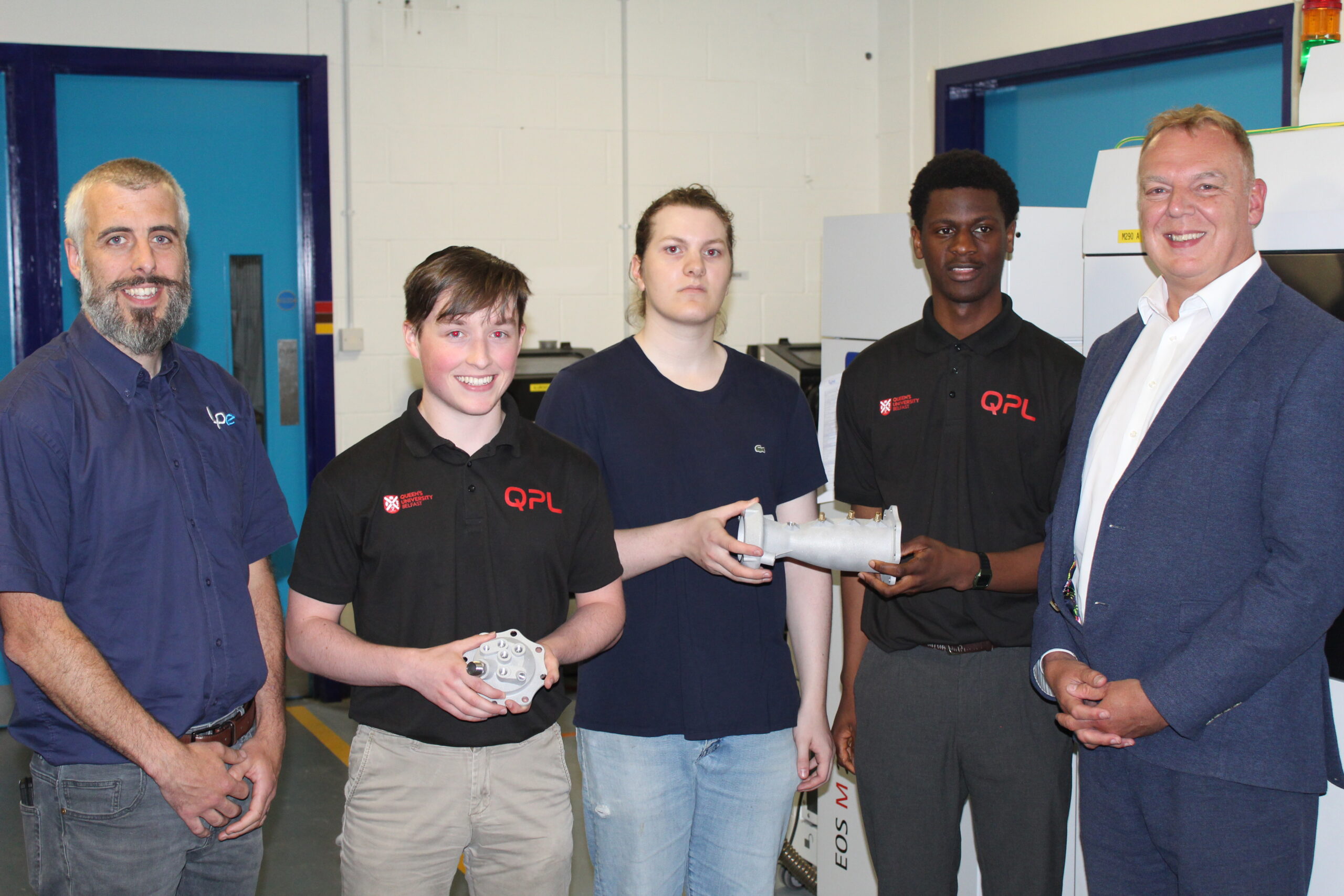
Students at Queen’s University Belfast have reached a major milestone for Northern Ireland’s growing space sector with the design and manufacture of Kelvin Mk.1, the island’s first student-developed liquid rocket engine, named after Lord Kelvin, the Belfast-born physicist renowned for his pioneering work in thermodynamics.
As part of their work with Queen’s Propulsion Laboratory (QPL), LPE partnered with the team to manufacture the engine’s critical component: a metal 3D printed liquid rocket engine, fully produced and post-processed at our Belfast facility.
Founded in 2023, QPL is Northern Ireland’s largest student rocketry team, giving students hands-on, real-world experience in aerospace engineering. Their liquid engine, powered by isopropyl alcohol and nitrous oxide, will undergo hot fire testing this July as part of the UK’s Race2Space national propulsion competition.

Metal Printed Rocket Engine chamber
Designed by Students, Built by LPE
Working closely with QPL, the LPE team helped refine the chamber for Direct Metal Laser Sintering (DMLS) in AlSi10Mg aluminium, ensuring the design was optimised for performance and manufacturability.
The component features integrated internal cooling channels, printed in a single build to eliminate stress-prone welds or joints and withstand high thermal loads. Post-processing included full depowdering, heat treatment, and surface finishing to meet aerospace-grade requirements.
“Additive manufacturing was the right solution for this engine, not just for its complexity, but because it enabled speed, precision, and performance in a single process,” said Patrick Walls, Engineering Director at LPE. “We’re proud to support such an ambitious and capable team, and to contribute to a project that represents the next generation of propulsion technology coming out of Northern Ireland.”

Post-Processing the Engine Surface
Fuelled by Innovation, Driven by Collaboration
The QPL team chose metal additive manufacturing to take advantage of design flexibility, shorter lead times, and part reduction, allowing more time for testing and integration.
“It also gave us invaluable experience in designing for additive manufacturing,” said the team.
Q&A with Queen’s Propulsion Laboratory
We asked the QPL team what made additive manufacturing the right solution and what they learned from the process:
Q: What made additive manufacturing the right choice for the rocket engine chamber?
“We chose additive manufacturing because it allowed us to print the complex internal geometries within the engine, which wouldn’t have been possible using traditional manufacturing methods. Printing the chamber as a single part meant no welds or joints, reducing stress points and lowering the risk of failures. It also gave us experience designing specifically for additive manufacturing and working closely with LPE.”
Q: Why metal 3D printing over traditional machining or casting?
“Metal 3D printing gave us greater design freedom, faster manufacturing, and fewer parts. This meant shorter lead times, giving us more time for engine testing and integration. Traditional machining or casting would have increased complexity and extended manufacturing time.”
Q: What performance or design benefits did the team gain from printing the chamber in metal?
“For our engine’s requirements, aluminium was ideal. It’s lightweight, has excellent thermal properties, and is cost-effective. The chamber was heat-treated after printing, further improving its ability to handle high thermal loads.”
Q: How do you see metal additive manufacturing shaping aerospace propulsion?
“We see metal additive manufacturing as a key technology shaping the future of space propulsion. It enables lightweight, high-performance components with complex designs and faster prototyping. As the industry pushes for cost-efficient, sustainable solutions, additive manufacturing will be central to innovation in reusable launch vehicles, satellites, and propulsion systems.”
Q: What were your impressions of the finished engine chamber?
“We were very pleased with the engine. The surface finish and print quality exceeded expectations. The chamber was surprisingly light, and LPE’s post-processing ensured full depowdering of internal channels for proper propellant flow. Cold flow tests confirmed consistent, uniform performance. LPE’s technical support and fast turnaround were invaluable.”
Engine Test Countdown
Queen’s Propulsion Laboratory is set to hot-fire Kelvin Mk.1 at Westcott Space Cluster on 10 July 2025, as part of Race2Space, a UK-wide programme designed to bridge the gap between academia and industry in rocket propulsion.
This project shows what’s possible when cutting-edge technology meets student-driven innovation.
Want to learn more about additive manufacturing for aerospace or propulsion systems?
Get in touch with our team or explore our metal 3D printing services.